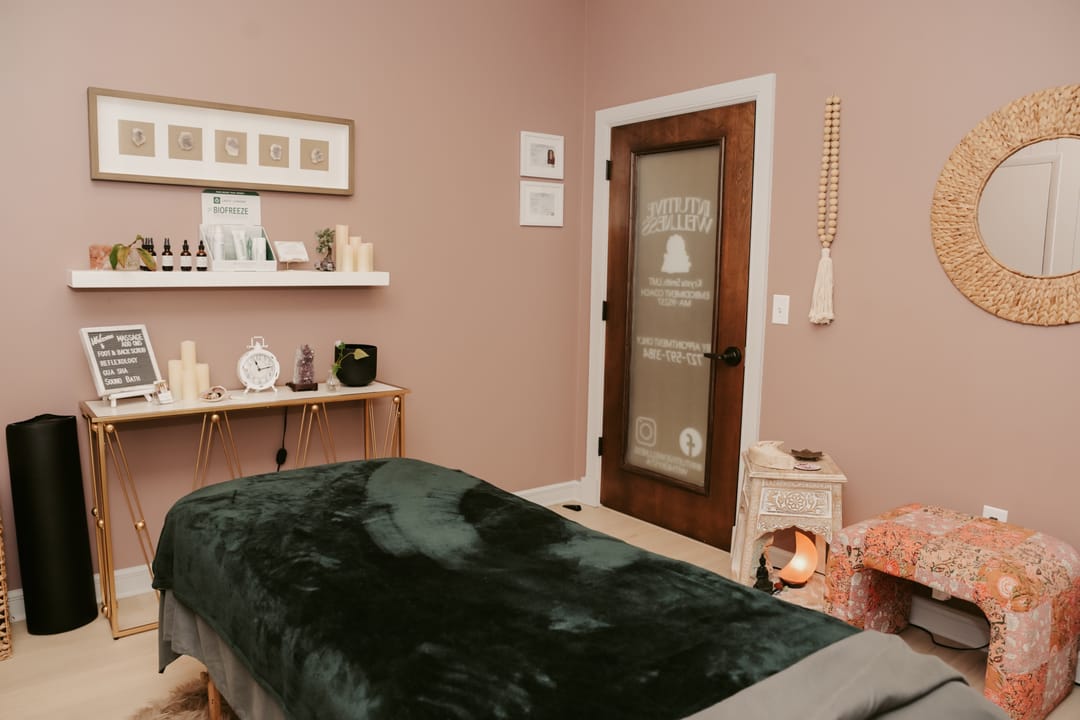
A halotherapy salt sauna is a quiet, dry room where you breathe fine salt in mild warmth. Most people book it because it feels calming and their breathing feels easier while they’re in it. The research on anything beyond that is early and mixed, so I’ll tell you what it does for how you feel, not what it treats. At my studio it’s one part of the Stillness Ritual, a 75-minute add-on that also includes the Sound Lounge and near-infrared light.
The short version
The Stillness Ritual is three things, back to back, in the same suite as my treatment room. You lie in the Sound Lounge, sit under near-infrared light, then rest in the HaloSalt sauna. It’s booked as an add-on to a session with me, so it either opens your appointment or closes it. You don’t have to do anything but show up and breathe.
What halotherapy is
Halotherapy is dry salt therapy. A small machine grinds pharmaceutical-grade salt into a fine dust and pushes it into the air of a sealed room. You sit or recline, breathe normally, and the salt settles on your skin and in your airways. The room at Stillness is kept at 88°F or less, with gentle infrared warmth, so it’s warm rather than hot.
What it feels like: a little like sitting by the ocean on a dry day. Your mouth tastes faintly of salt, and a lot of people simply fall asleep.
What I can say about it honestly: the relaxation part is real, and it’s supported by everything the NCCIH says about quiet, slow-breathing practices in general. The respiratory claims you’ll see elsewhere, about clearing airways or easing asthma or allergies, are based on early, mixed research. None of it is strong enough for me to promise you anything. If you have a lung condition, ask your provider before you book it, and treat it as a quiet room, not a treatment.
What near-infrared light is
Near-infrared (NIR) light sits just past visible red on the spectrum, in the range of roughly 700 to 1,100 nanometers. You can’t see most of it, but you can feel it as gentle warmth on your skin. There is no UV in it, so it doesn’t tan or burn you.
You sit or lie in front of a panel for 20 minutes. Many clients book it after a facial or a massage because their skin feels soft and their muscles feel loose afterward.
Cleveland Clinic’s take on red and near-infrared light is the one I follow: promising in a few areas, such as skin and short-term soreness, but with more research needed before anyone can say what it does for sure. So I’ll say the same. Warm, gentle light. Research is early. Book it for how it feels.
The Sound Lounge
The Sound Lounge is a room built around sound and vibration. You lie on a table that lets you feel low frequencies through your body while recorded tones play around you. The idea is the same one behind a live sound bath: give your attention something simple to hold so the rest of you can slow down. Cleveland Clinic describes sound baths as a form of meditation that can help with stress and mood, and that matches what people tell me.
I wrote a longer piece on what sound does to the nervous system, including how the lounge differs from a live session with me in the room. The short answer is that the lounge is quieter and more private, and a live sound meditation is more responsive, because I’m playing to how you’re breathing.
Before or after your massage?
Either works. They do different jobs.
Before a massage, the ritual warms your tissue and settles your mind. By the time you’re on my table your shoulders have already dropped, so the hands-on work starts from a quieter place. This is my favorite order for a Therapeutic Massage, because warm, relaxed muscle lets me go deeper without you guarding against the pressure.
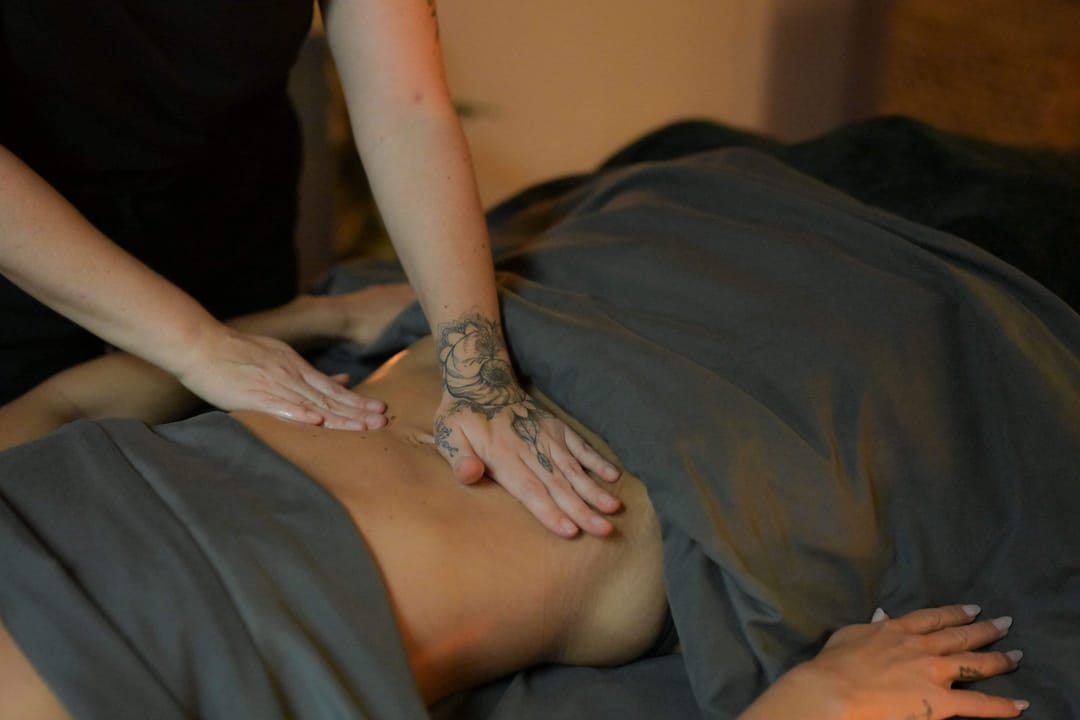
After a massage, the ritual keeps you in the quiet instead of sending you straight back to the parking lot. I like this order after Lymphatic Drainage. The massage is light and slow, and 75 minutes of salt, light and sound afterward lets that stillness carry on. If you’re someone who feels tired after lymphatic work, the sauna is a good place to let that happen.
If you’re not sure, tell me what you’ve booked and I’ll suggest an order.
The smaller rituals
You don’t have to do all three. Stillness & Aesthetics Co. and I offer the pieces on their own, and every one is an add-on to a session with me:
- Resonance Ritual: NIR light plus the Sound Lounge, 30 minutes.
- Purification Ritual: the dry salt sauna on its own, 55 minutes.
- Radiance Reset: NIR light on its own, 20 minutes.
- The Stillness Ritual: all three, 75 minutes.
Current rates for each are on the pricing page. The ritual time is added to your appointment, so a 60-minute massage with the full Stillness Ritual means a little over two hours at the studio. Don’t book it on a day you have to rush out.
Everything about the suite, including photos and the full list of what’s there, is on the Stillness & Aesthetics Co. page.
Who should check with a provider first
These rooms are for relaxation and general wellness. They aren’t medical treatment, and I’m not a doctor. Please ask your provider before booking if any of these apply to you:
- You’re pregnant.
- You have asthma, COPD or another respiratory condition.
- You take a medication that increases light sensitivity.
- You’ve had surgery in the last few weeks.
Once they’ve said yes, tell me when you book.
Questions people ask
Do I need a massage booked to use Stillness?
No. Stillness & Aesthetics Co. takes its own bookings for the lounge, light and sauna. The rituals on my menu are for adding to a session with me, which is the simplest way to do both in one visit.
Is the salt room hot?
Mildly warm, 88°F or less. It’s a dry salt room with gentle infrared, not a traditional sauna. You won’t sweat much, and you can wear whatever you’re comfortable in.
Can I do NIR light if I’m pregnant or on medication?
Ask your provider first. Some medications increase light sensitivity, and pregnancy changes what’s sensible. I’d rather you check than guess, and I’m happy to swap the light for more time in the sound lounge.
This is general information, not medical advice. Check with your provider about your own situation.