The short version
Thai foot reflexology is firm, point-by-point pressure on the feet and lower legs, done with the thumbs and a smooth wooden stick. You stay clothed to the knee, it lasts 30 or 60 minutes, and most people leave feeling grounded and heavier in a good way. The stick is there for precision, not show.
That covers the question most people arrive with. Below is where the practice comes from, why I use the stick, what the session feels like minute by minute, and how to fit it next to other things on the menu.
Where it comes from
Thai foot reflexology grew out of traditional Thai medicine, which pictures the body as crossed by energy lines called sen. The feet are where a lot of those lines are said to begin, so working the feet is treated as working the whole body. Chinese and Indian foot practices fed into it over the centuries, and the sequence I learned follows a set map of points on the sole, arch, toes and heel.
I want to be straight about what that map is. The traditional idea is that each point relates to an organ or a body system. The research, summarised by the National Center for Complementary and Integrative Health (NCCIH), supports reflexology for relaxation and reduced tension; it does not support treating conditions in other organs. So I use the map as a sequence, and I don’t tell you your liver point means anything about your liver. People book this because their feet hurt and they want to feel calmer, and it does both of those well.
Why the stick
The stick is a short, smooth piece of hardwood, rounded at one end and tapered at the other. I warm it in my hands and run a little oil over it before it touches your skin, so it glides instead of dragging.
It does three things a thumb can’t. First, precision. Reflex points on the foot are small, and the tapered end lands on one point without spreading pressure across the ones next to it. Second, steadiness. I can lean into the stick and hold an even pressure for a slow count, where a thumb starts to shake and drift. Third, it saves my hands. Thumbs wear out over a day of feet, and a tired thumb means uneven work by the last client. The stick keeps the fortieth point as clean as the first.
It never scrapes or digs. If anything feels sharp rather than deep, say so, and I change the angle or ease off.
What a session feels like
You sit back or lie down with your pants rolled above the knee. I wash and wrap your feet in a hot towel for a minute or two, which softens the skin and gets you breathing slower before anything else happens.
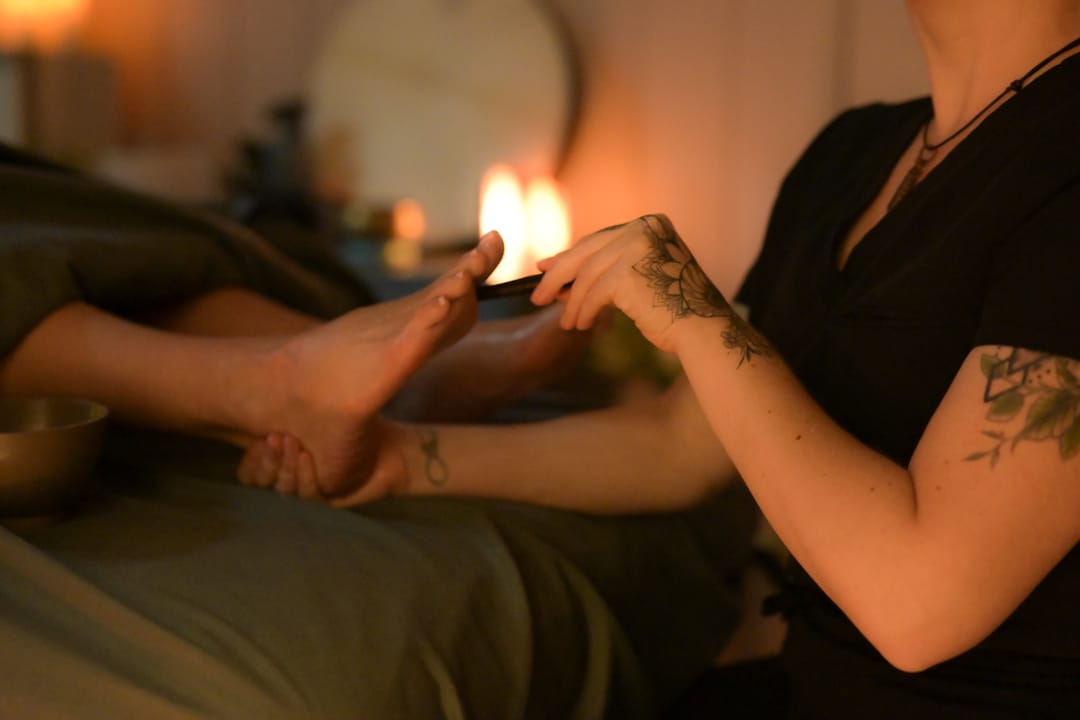
Then the stick work starts, one foot at a time, point by point from the heel up to the toes. Each point gets a few seconds of steady pressure. Some feel like nothing. A few will feel tender, the kind of ache that makes you exhale, and those are usually the spots that match where you’ve been standing or tense all week. Tell me if one is too much. Firm is the goal, not bracing.
After the stick I use my thumbs to walk the arch and the ball of the foot, then knead the toes and rotate the ankle. In a 60-minute session I move up into the calf and shin with compression and long strokes, then stretch the ankle and calf. The finish is another hot towel and a few quiet minutes where I leave you alone. Most people are half asleep by then. Clients often tell me they sleep well that night, which matches what the AMTA and NCCIH describe about massage and relaxation generally.
30 or 60 minutes
Thirty minutes is the feet, start to finish: hot towel, both feet with the stick, thumb work and the towel to close. It’s a complete session, not a taster. Pick it if your feet are the whole complaint or you’re short on time.
Sixty minutes adds the lower legs and slows everything down. Calves get compression and stretching, the ankles get more attention, and each point gets held a little longer. If you’re on your feet all day, run, or have tight calves that pull on your heels, 60 is the one. Both lengths are listed on the Reflexology Massage service page, and current rates are on the pricing page.
Two other ways to get it. Mini Reflexology is a 30-minute add-on you can attach to any table session, so you can finish a massage with your feet done. And the NeoLifting® + Facial + Reflexology tier on the NeoLifting® page puts face and feet in the same appointment, which is the most relaxed I see people leave.
Pairing with Thai massage
Reflexology and Thai massage come from the same tradition, and they fit together. Ayurvedic Thai Massage is a clothed, mat-based session of compression and assisted stretching that always starts at the feet anyway. Booking reflexology first means the feet and lower legs are already open and soft when the stretching starts, and the sen lines I’m following on the mat are the same ones I worked with the stick.
If you want to stay clothed and be worked on from the ground up, that pairing is the closest thing I offer to a full traditional Thai session. If you’d rather not be stretched, reflexology on its own is a quieter hour with the same starting point.
Questions people ask
Does reflexology treat problems in other organs?
That is the traditional belief behind the point map. The research supports relaxation and reduced tension; it doesn’t support treating organ conditions, and I don’t claim it does. If you have a medical concern, see your provider, and come to me for the feet.
Is it ticklish?
The pressure is firm enough that most ticklish people are fine. Tell me and I’ll start with more pressure, not less. Light touch is what tickles, so we skip it.
Can I book it with something else?
Yes. Mini Reflexology is a 30-minute add-on to any main service, and it’s built into the NeoLifting® + Facial + Reflexology tier. It also sits well before a Thai massage.